Grasshopper Threat Builds in the Basin
KID Launches a local reporting tool as dry, fallowed ground raises concern for another hard season.
A grasshopper rests on vegetation near Stateline Road outside Merrill during the 2023 outbreak, when producers across the Basin reported heavy pressure on crops, pasture and field edges. Photo: Chelsea Shearer
“We know how fast this can turn. During the 2023 invasion, one patron lost 80 acres of grain in a single day.”
Updated: 3:29 pm, 6/22/26
KLAMATH FALLS, Ore. — Grasshoppers and Mormon crickets are active again across the Klamath Basin, raising concern among producers after previous outbreaks caused rapid crop losses and left fields vulnerable across the region.
Klamath Irrigation District says grasshoppers are already hatching across the Basin. According to a field notice sent to Klamath Project producers, they have been observed “pouring out of the ground” at the Lower Klamath National Wildlife Refuge, while producers along the Oregon-California state line have already treated several times this spring.
KID patrons are also reporting every stage of grasshopper development, from newly hatched nymphs to full-grown adults, in the Van Brimmer Ditch Company area and dry ground along the state line.

“We know how fast this can turn,” Gene Souza, executive director of Klamath Irrigation District, wrote in the notice. “During the 2023 invasion, one patron lost 80 acres of grain in a single day.”
The concern this year is not only that grasshoppers are appearing, but that conditions across the Basin may allow populations to build quickly. KID says nearly 50,000 acres of dry or fallowed land are present in 2026, creating prime habitat for grasshoppers and Mormon crickets.
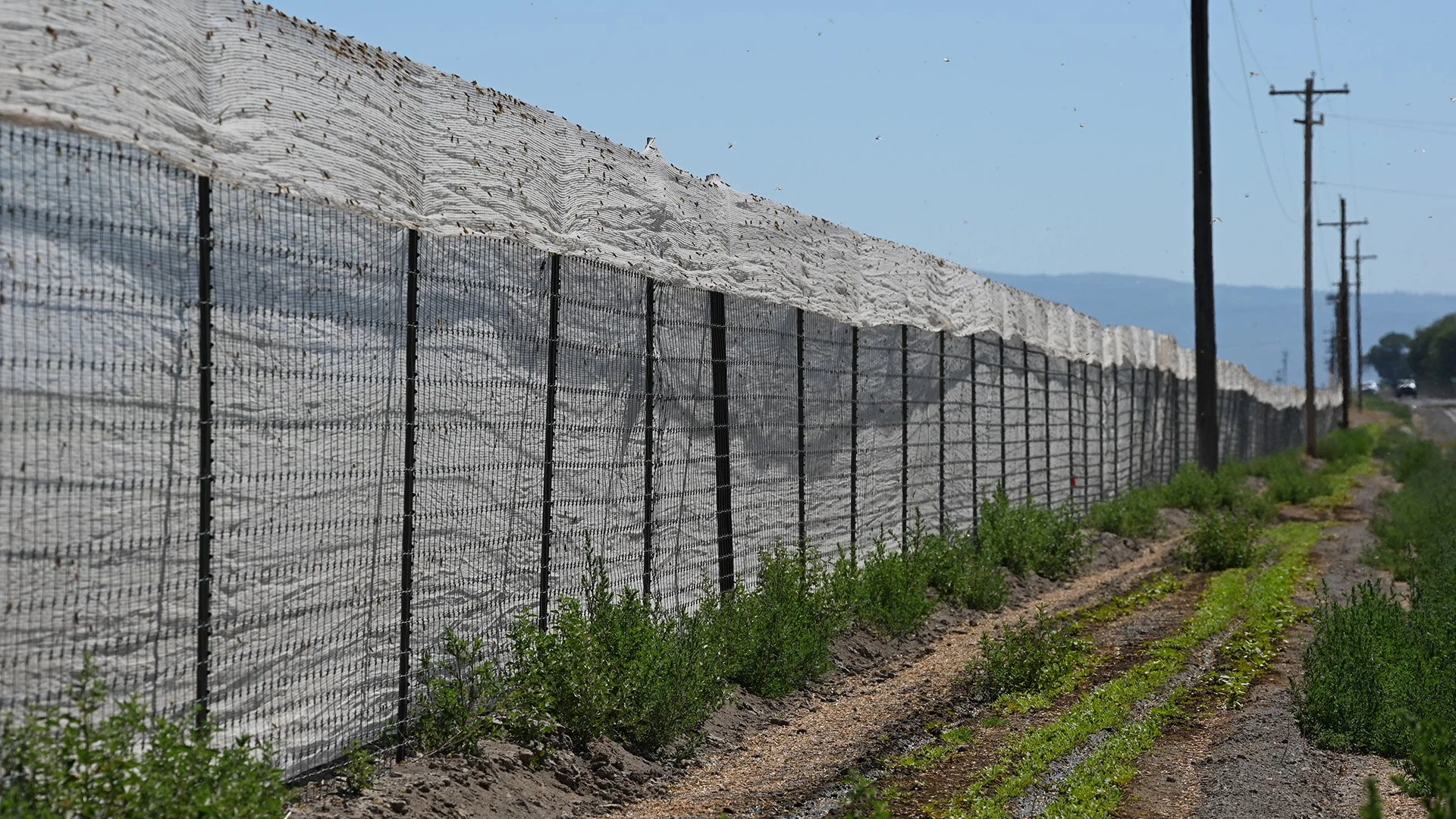
Grasshoppers covered fencing near Stateline Road outside Merrill during the 2023 outbreak, showing the scale of the pressure Basin producers faced as insects moved across dry ground and toward working fields. Photo: Chelsea Shearer
"Many Basin farmers and ranchers are still remembering the impacts of the 2023 grasshopper outbreak,” said Elizabeth Nielsen, Executive Director for Klamath Water Uses Association.
"Once these populations explode, the damage can happen literally overnight, eating hundreds of acres a day,” added Nielsen. “That's why public reporting is so important. Every sighting helps build a clearer picture of where infestations are developing and where management efforts may be needed.”
At outbreak levels, grasshoppers and Mormon crickets can feed on leaves, stems and seed heads. KID says they often begin at field edges and work inward, moving to the next field once forage is consumed. Grain, alfalfa and pasture are all at risk, and even when a crop stand is not completely destroyed, insect feeding can reduce both yield and quality.
Grasshopper outbreaks are not new to Oregon, but drought conditions and warm spring weather can make them worse. According to Oregon Department of Agriculture materials, grasshopper season begins in April when eggs laid the previous fall emerge from the soil. Hatches can continue into July depending on elevation, soil moisture, temperature and the specific species involved.
Dead grasshoppers covered the roadside on Stateline Road near Lower Klamath Lake NWR during the 2023 outbreak, a reminder of how quickly large populations can build across dry ground and move toward fields. Photo: Chelsea Shearer
ODA has also warned that outbreaks often follow or coincide with drought years, when low rainfall and warm spring weather create favorable conditions for eggs to hatch and young nymphs to survive. As rangeland forage dries out or is consumed, grasshoppers may move into pastures and irrigated cropland.
That timing is important because young grasshoppers are easier to manage before they mature and spread. ODA materials note that nymph surveys typically begin in April and continue into early July, while treatments that target nymphs are generally most effective from late May to late July.
But KID says there is now a local gap in reporting support.
“The Oregon Department of Agriculture is no longer funding its grasshopper and Mormon cricket reporting portal, so Klamath Irrigation District has built a new one,” Souza wrote.
Grasshoppers filled the air over a field near Stateline Road outside Merrill during the 2023 outbreak, when swarms created serious concern for Basin producers and standing crops. Photo: Chelsea Shearer
The new KID reporting form is intended to collect sightings across Klamath, Modoc and Siskiyou counties. The district says reports from producers and landowners will help KID and partner agencies map where grasshoppers and Mormon crickets are building before they reach standing crops.
“If you see grasshoppers or Mormon crickets on your ground — in Klamath, Modoc, or Siskiyou County — please take two minutes to report it,” Souza wrote. “The more we know about where they are and how thick they’re getting, the better the District and partner agencies can target a response.”
KID says the form works from a phone in the field or from a computer and asks users to report where insects are seen, roughly how many are present, what life stage they appear to be in, what they are feeding on and whether treatment has already occurred. Photos may also be added.

Useful reports may include the nearest road, canal or field; whether the insects are a few in number or thick across the ground; whether they appear as tiny nymphs, mid-size insects or full-grown adults; and whether they are on bare ground, pasture or a standing crop.
The district says early reports can make a significant difference.
“Grasshoppers and Mormon crickets are active across the Basin this year,” KID said. “If you see them on your ground, tell us where. Your reports help the District and partner agencies map where the insects are building and respond before they reach standing crops.”
“We commend the Klamath Irrigation District for stepping up and creating a grasshopper and Mormon cricket reporting system, where state resources are lacking,” said Nielsen. “Providing timely, local information is one of the best ways to identify emerging infestations early and help protect Basin farmers and ranchers from potentially devastating losses."
Report a sighting:
https://klamathid.org/home/resources/grasshoppers-and-mormon-cricket-reporting/
KID said the goal is to stay ahead of the problem while producers still have time to respond, especially with dry ground and scarce forage already setting up a difficult season.
“A two-minute report from your field is the most useful information there is,” the district said.
Cover image: Grasshoppers are active again across the Klamath Basin, where dry and fallowed ground is raising concern for another difficult season for farms, pastures and standing crops. Photo: Klamath Irrigation District