Drought Relief Workshop Set for Klamath Project Irrigators
The Klamath Project Drought Response Agency will host a Friday workshop at KWUA ahead of a June 15 application deadline for 2026 drought relief programs.
Idle agricultural land is seen among fields in production in the Henley area of Klamath County, where the Klamath Irrigation District serves portions of the Klamath Project. The Lost River runs through the landscape. Photo by Chelsea Shearer.
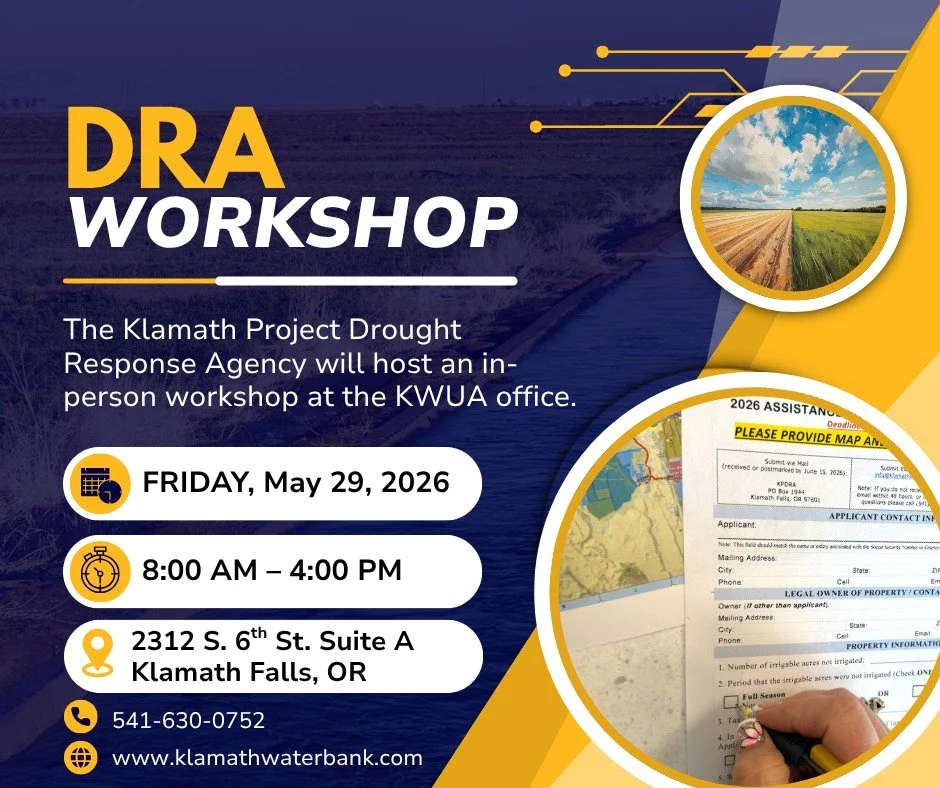
KLAMATH FALLS, Ore. – Klamath Project irrigators have an upcoming opportunity to learn more about 2026 drought relief programs during a Friday workshop at the Klamath Water Users Association office in Klamath Falls.
The Klamath Project Drought Response Agency is holding the workshop from 8 a.m. to 4 p.m. Friday, May 29, at KWUA, 2312 South Sixth Street, Suite A.
Applications for the 2026 assistance programs are due by 5 p.m. June 15.
The programs are designed to help align available Klamath Project water supplies with irrigation demand during a difficult water year. Program materials state that forecasts from the Natural Resources Conservation Service and Bureau of Reclamation indicate inflows to Upper Klamath Lake will be below normal in 2026, resulting in a water supply that will not meet full irrigation demand within the Project.

For agricultural producers, the programs offer a way to evaluate available drought relief options while making difficult operational decisions for the remainder of the irrigation season.
The available programs include a no-irrigation program, a limited-irrigation program and a five-year assistance program focused on demand reduction.
The no-irrigation program lists payments of $425 per acre for eligible full-season parcels and $212.50 per acre for eligible partial-season parcels.
The limited-irrigation program lists payments of $212.50 per acre for eligible perennial crops and $75 per acre for eligible annual crops, with qualifying participants required to discontinue irrigation after 5 p.m. May 27 through Oct. 31.
The five-year assistance program is intended for longer-term demand reduction and includes annual participation from 2026 through 2030, subject to program requirements, verification and available funding.

Irrigators are encouraged to review the full program policies before applying, as each program has specific eligibility requirements, application materials and verification rules.
Application materials may be submitted by email to info@klamathwaterbank.com, by mail to KPDRA, PO Box 1944, Klamath Falls, OR 97601, or in person at Parks & Ratliff, 620 Main Street in Klamath Falls. Applications must be received by the June 15 deadline.
More information and program materials are available at klamathwaterbank.com.
The workshop offers irrigators a chance to review their options, ask questions and prepare applications before the deadline.
For Klamath Basin agriculture, the assistance programs arrive during another challenging irrigation season, when producers are balancing water availability, crop decisions, land stewardship and the economic realities of farming in one of the West’s most closely watched water basins.
Cover image: Agricultural lands within the Klamath Drainage District are seen from above in the Klamath Basin. A Friday workshop will help Klamath Project irrigators review 2026 drought relief program options ahead of the June 15 application deadline. Photo by Chelsea Shearer.